The agreement between DFT and CASSCF of a Cr(I)-Cr(I) study
- Andrej Hlinčík
- Flash-Talks 2 , Chemistry
- Wednesday, July 16, 2025
- 12:00 pm
Andrej Hlinčík, Lukáš Bučinskýa, Jozef Kožíšek
Institute of Physical Chemistry and Chemical Physics, Faculty of Chemical and Food Technology, Slovak University of Technology in Bratislava, Radlinského 9, SK-812 37 Bratislava, Slovak Republic.
e-mail: andrej.hlincik@stuba.sk
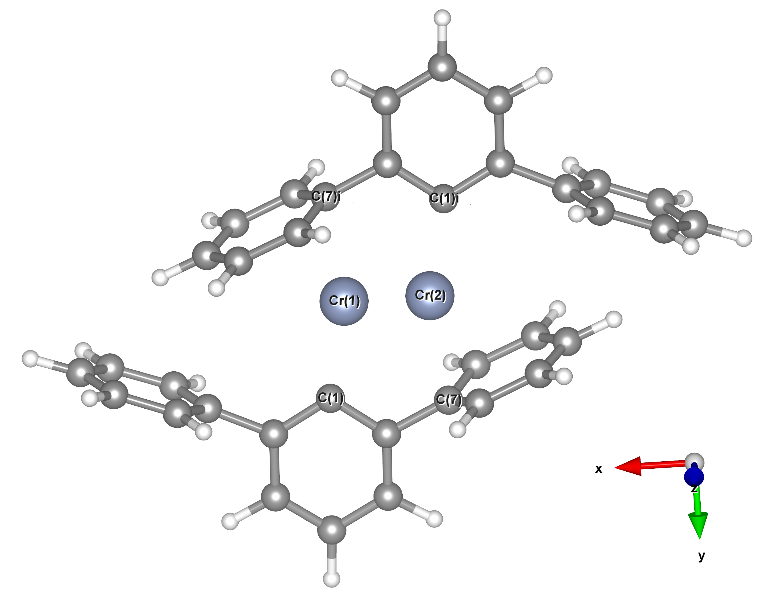
Structure of complex S derivated from SIYNAQ (CCDC code: 681728)
The metal-metal interaction fascinated scientist for many years. In this study, the Cr(I)-Cr(I) bond of complex S [1] was studied by both single- and multi-determinant approaches.
The pure BLYP and hybrid B3LYP (with/without D3 correction), as well as the ωB97X-D and M06-2X DFT functionals were tested against the multideterminant CASSCF/NEVPT2 approach. Several parameters considered showcase many common features with the pure BLYP calculation than one would expect. To further analyse the formal bond order, the Quantum theory of atoms in molecules was used [2].
Due to several spin state options, it is of interest to find how the spin state preference affects the calculation of structure factors and what the differences between them are.
Acknowledgement: We are grateful to Slovak Grant Agencies APVV (contract No. APVV-20-0213) and VEGA (1/0175/23 and 1/0324/24).
References:
[1] R. Wolf et al., Inorganic Chemistry, 46, 11277-11290 (2007).
[2] R. F. W. Bader, Atoms in Molecules: A Quantum Theory, Oxford University Press, 1990.