Electron Density Studies on Cobalt Single-Molecule Magnets
- Katharina Rachuy
- Flash-Talks 1 , Chemistry
- Monday, July 14, 2025
- 12:51 pm
Katharina Rachuy, Regine Herbst-Irmer, Dietmar Stalke
Georg-August-Universität Göttingen
e-mail: k.rachuy@stud.uni-goettingen.de
In 2021 Stalke et al. analysed several tetrahedral distorted Co2+ complexes and predicted that a bite angle between 76-78° maximises the magnetic anisotropy, as it minimises the energy gap between the dxy and dx2-y2 orbital. The closer the orbitals are in energy, the larger is the magnetic anisotropy[1]. Overgaard et al. predicted an energy barrier Ueff of 342 cm‑1 for the case of the dxy and dx2-y2 orbital being degenerated [2,3]. In the present study, two complexes with significant magnetic anisotropy, Co{(NtBu)2SPh}2 and Co{(N(tms))2SPh}2, were subjected to charge density investigations based on high-resolution X-ray diffraction data, to achieve a better insight into their magnetic properties especially through the d-orbital population. Further on, we did calculations [4,5] on the complexes and obtained from that d-orbital populations as well, to validate and interpret the experimental results.
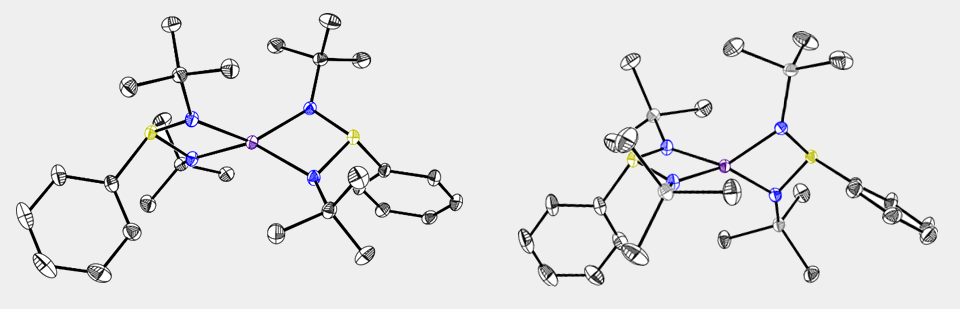
The complexes, one the left with tBu groups, and on the right with tms. Anisotropic displacements are depicted on a 50% probability level, hydrogen atoms are omitted for clarity.
References:
[1] C. M. Legendre, E. Damgaard–Møller, J. Overgaard, D. Stalke, Eur. J. Inorg. Chem. 2021, 3108–3114.
[2] E. Damgaard-Møller, L. Krause, K. Tolborg, G. Macetti, A. Genoni, J. Overgaard, Angew. Chem. Int. Ed. 2020, 59, 21203–21209.
[3] E. Damgaard-Møller, Dissertation, Aarhus University, Aarhus, 2020.
[4] F. Neese, F. Wennmohs, U. Becker, C. Riplinger, J. Chem. Phys., 2020 152.
5] A. Genoni, Acta Cryst. A 2020, 76, 172–179.